

Cats can have big personalities. Some wear them loudly, demanding attention and staking out territory like they own the house. Others keep everything tucked behind quiet eyes and perfect posture. Even when a cat doesn’t appear outwardly stressed, stress can quietly shape your relationship in ways you might not immediately recognize.
It may show up as hesitation at the litter box, sudden aggression in a multi-cat home, hiding, overgrooming, or a cat who simply seems different than usual. It’s easy to label these moments as misbehavior, especially when they disrupt the rhythm of your household. But most of the time, your cat isn’t acting out. Your cat may be coping with something you can’t yet see.
Understanding what stress looks like (and what drives it biologically) can prevent problems before they strain your home and your bond. Let’s take a closer look at what stress really does to a cat’s mind and body.
Animals respond differently to stress than humans, and cats respond differently to stress than many other companion animals. Remember that cats evolved as both predator and prey. That dual role shaped a nervous system built for vigilance. Their senses are tuned to subtle changes in scent, sound, and movement. What feels minor to us can register as significant to them.
Cats thrive on predictability. Structure and routine create security within their territory. Sudden changes, unfamiliar scents, inconsistent access to resources, or disruptions to established patterns can activate stress responses even if nothing looks dramatic on the surface.
Setting your cat up for success is not complicated, but it does have to be intentional. Provide a calm, safe environment. Offer targeted play that mimics predatory behavior. Feed a biologically appropriate diet. Ensure key resources are consistently available: food, fresh water, litter box access, scratching areas, resting spaces, and vertical perches. Pair that with predictable, respectful human interaction. These fundamentals go a long way toward supporting emotional stability and physical health.
Chronic, subtle stress often stems from:
None of these are dramatic in isolation. But stress is cumulative, and small disruptions repeated over time can produce meaningful biological effects.
We’ve talked about some of the outward signs of stress in cats. Now let’s go over what happens inside your cat’s body during a stress response.
Stress response is commonly described as fight, flight, or freeze. This response is not philosophical; it’s physiological. When a cat’s brain interprets a threat, whether that threat is a territorial conflict, a sudden change in scent, or an unpredictable routine, it activates the sympathetic nervous system (commonly referred to as the “fight or flight” response).
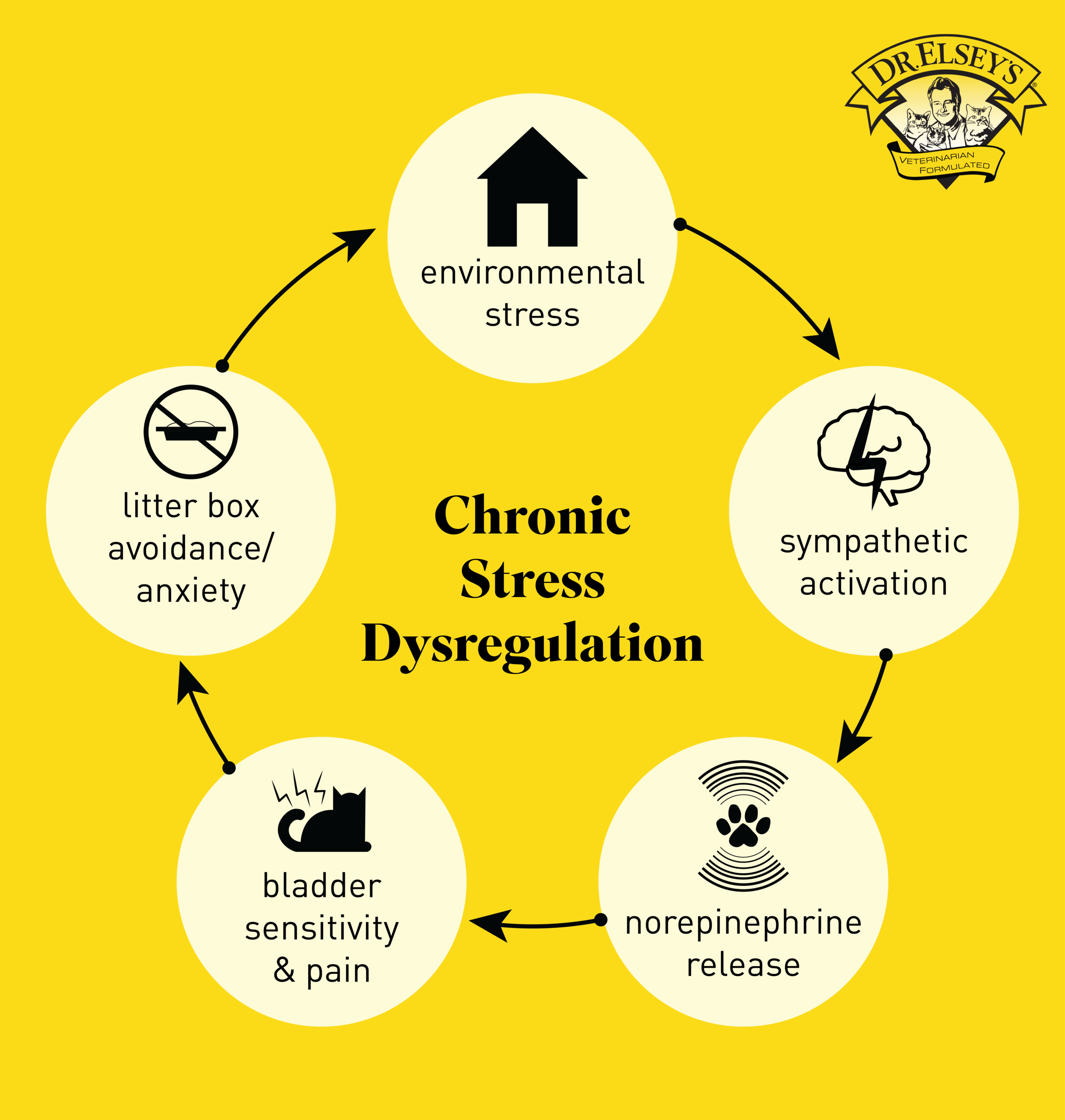
During this activation, stress hormones like cortisol and adrenaline are released. Heart rate increases. Muscles tense up. Digestion slows down. This is because the body prioritizes survival over comfort.
In short bursts, this response is protective. However, problems arise when the sympathetic nervous system remains activated for extended periods.
In modern homes, the “threat” is rarely a predator. More often, it is chronic environmental stress in the form of multi-cat tension, overstimulation, inconsistent resources, or sensory overload. When stressors persist, cortisol levels can remain elevated. Sustained cortisol elevation can disrupt inflammatory regulation, immune balance, and normal bladder function.
Research in feline medicine links chronic stress to changes in bladder health, gastrointestinal function, immune regulation, and skin integrity. Cats experiencing prolonged stress are more prone to conditions such as idiopathic cystitis, digestive upset, and excessive grooming.
Chronic stress does not merely alter behavior. It alters physiology.
If stress hormones influence digestion, muscle tension, and immune function, it’s not surprising that one of the first places chronic stress appears is in the litter box.
The bladder is particularly sensitive to stress in cats. In some stress-related conditions such as feline idiopathic cystitis (FIC), the stress response system itself becomes dysregulated.
Research suggests that many cats with FIC do not mount a typical cortisol response to stress. Instead, they may exhibit a blunted adrenal response alongside heightened sympathetic nervous system activity. Chronic activation of this system increases the release of norepinephrine, a neurotransmitter associated with vigilance and pain sensitivity.
The result is a bladder that becomes more reactive, more inflamed, and more sensitive — even in the absence of infection.
In other words, it is not simply “too much stress hormone.” It is an imbalance in how the stress system regulates itself.
Beyond internal physiology, stress also influences behavior around going to the bathroom. A cat who feels uncertain or overstimulated may begin to avoid the litter box if something about it feels unpredictable – a new scent, a dusty cloud, a different texture, or a location that suddenly feels exposed.
From a cat’s perspective, the litter box is not simply a bathroom. It is a vulnerable moment. If the environment feels unstable, that vulnerability becomes magnified.
This is why consistency matters. Stable routines, predictable resources, clean air, and respecting a cat’s sensitive sense of smell all reduce unnecessary stress around elimination. Small environmental adjustments can make a meaningful difference.
When a litter box issue arises, it’s tempting to frame it as defiance. More often, it’s communication. Something has shifted, and the cat is responding the only way it knows how.
Stress in cats is rarely dramatic. It’s subtle, layered, and cumulative.
A cat who hides more. A cat who grooms excessively. A cat who refuses the litter box. These are not personality flaws. They are signals. Once you pick up on those signals, your perspective will begin to shift.
Before assuming misbehavior, ask what might have changed. Was a routine disrupted? Has scent or air quality shifted? Is there competition or something new entering the territory?
Your cat is not being difficult. Your cat is navigating its environment the way its biology designed it to. Once you understand that behavior is communication, you stop correcting symptoms and start stabilizing the environment that drives them.
In the next article in this series, we’ll take a closer look at the specific stress signals cat parents often miss – and how to recognize them before they turn into larger problems.