

Stress in cats is often environmental. It affects the body and shows up in behavior. When the environment changes, outcomes can change with it. The question is where to start.
Keep reading to learn how to build an environment that prevents the stress you just learned to recognize.
The essential aim for pet care is to provide environmental intervention grounded in veterinary standards. FelineVMA’s 5 Pillars of a Healthy Feline Environment provides a practical framework for strengthening the bond between you and your cat.
1. Provide a Safe Place
2. Provide Multiple and Separated Key Resources
3. Provide Opportunity for Play and Predatory Behavior
4. Provide Positive, Consistent, and Predictable Human-Cat Interaction
5. Provide an Environment that Respects the Cat’s Sense of Smell
These pillars are based on how cats naturally interact with their environment, not how humans prefer to organize it.
Now, let’s get into practical ways you can check off all 5 pillars.
Before making changes to your home, start with your resources. Food, water, and litter setup form the foundation of your cat’s environment.
Provide food consistently, whether that means scheduled meals or maintaining availability depending on your cat’s needs. Multiple water sources are ideal, and many cats prefer moving water, making a fountain a useful upgrade.
Litter setup matters just as much. Boxes should be large, accessible, and available in sufficient number, especially in multi-cat households. When resources are easy to access and free from competition, tension decreases and daily routines become more stable.
Cats rely heavily on scent to interpret their environment. Strong or unfamiliar odors can disrupt a cat’s sense of stability.
Avoid introducing unnecessary fragrances into your cat’s space. This includes scented litter, candles, cleaning products, and personal fragrances. The litter box should remain a neutral and predictable area.
When scent remains stable, cats are more likely to recognize their environment as safe, which reduces stress and supports consistent litter box behavior.
Dust is easy to overlook, but it plays a direct role in your cat’s comfort. Fine particles can linger in the air and settle on surfaces your cat uses every day, including the litter box.
Choose a low-dust litter and handle it carefully. Pouring slowly and close to the box helps prevent particles from spreading through the air and into your cat’s environment.
While dust is often seen as something to eliminate entirely, a small amount serves a functional purpose. Fine particles help coat waste quickly, improving clumping and helping contain moisture and odor at the source.
The goal is not zero dust, but controlled dust. When particles stay where they’re needed and out of the air, you maintain performance while reducing unnecessary irritation and environmental stress.
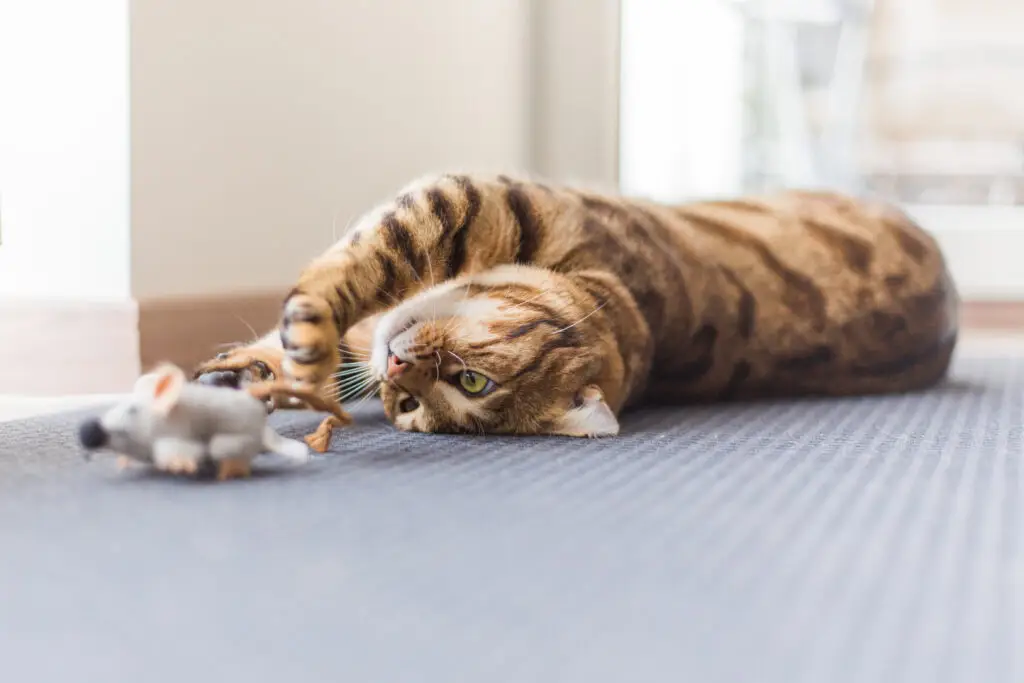
Constructive play gives cats an outlet for instincts they cannot turn off. Stalking, chasing, grabbing, and kicking are hardwired behaviors that require expression.
Provide daily opportunities for play that mimic the natural hunting sequence. Wand toys, moving objects, and soft toys that allow kicking can help simulate this experience.
When these needs are met consistently, excess energy is released in a controlled way, resulting in a calmer and more settled cat outside of play.
Cats rely on predictability to feel secure. When routines, movement, or access to resources become inconsistent, vigilance increases and stress can follow.
Establish consistent daily patterns. Feed at the same time, maintain regular portions, and keep key resources stable in both location and availability. Introduce changes gradually to avoid unnecessary disruption.
What you feed matters just as much as when you feed. Biologically appropriate nutrition, high in animal-based protein and low in carbohydrates and plant matter, supports your cat’s natural physiology and helps reduce internal stress. Diets high in carbohydrates, plant-based ingredients, or excess fiber can place unnecessary strain on digestion. In a true carnivore with a short digestive tract, excess fiber can dry out feces in the colon and cause constipation, which aggravates stress over time.
Key Takeaway: Predictability reduces uncertainty. When a cat can rely on its environment, stress decreases, behavior stabilizes, and overall health improves.
Stress in cats is not random. It is shaped by the environment, expressed through behavior, and reflected in the body. Once you understand how these pieces connect, the path forward becomes clearer.
You don’t need to overhaul everything at once. Small, consistent changes to your cat’s environment can reduce stress, improve behavior, and support long-term health.
When you create a stable environment that respects your cat’s instincts, you’re not just preventing problems. You’re building trust and strengthening the bond you share. When you adjust the environment, you influence behavior before it becomes a health issue.