

It doesn’t feel like interruption. It feels like being ignored.
When your cat disengages, walks away, or appears dismissive, they’re not tuning you out. They’re tuned into something you’ve stepped into the middle of.
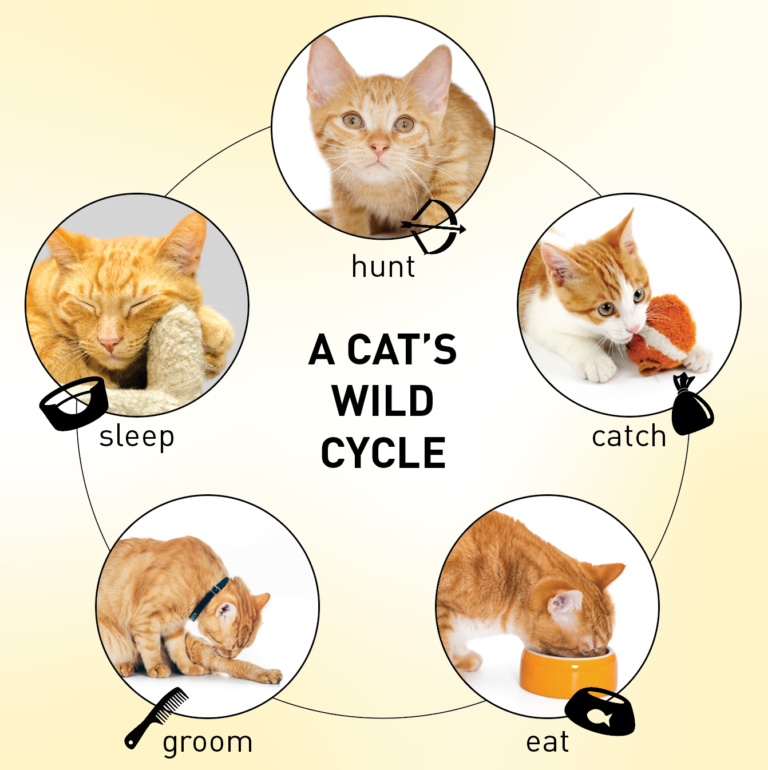
Cats live by a simple cycle, which is:
Hunt → Catch → Eat → Groom → Sleep
Then it repeats. This is a cat’s wild cycle. It’s a simple concept, but it drives everything.
This cycle isn’t just about enrichment. It’s how a cat’s nervous system regulates. Each step leads into the next. When the cycle runs without interruption, your cat settles.
What we see as healthy interactions can be interruptions to our cats. This might look like petting during rest time, picking a cat up mid-transition, random (even erratic) play attempts, inconsistent feeding times, as well as interruptions during grooming or settling.
These aren’t random moments. Your cat is already in motion. Interruptions to your cat’s wild cycle cause stress. And stress changes behavior.
Cats aren’t built to chase things down over distance. They’re not endurance hunters like dogs are. Cats are stalk-and-rush hunters.
That means they spend most of their time doing very little. Watching. Waiting. Positioning. Then, in a short burst, everything happens at once.
That pattern shapes the entire wild cycle. To cats, stillness isn’t inactivity. It’s preparation. The burst isn’t random. It’s the release.
Stress rarely comes from one big moment. It builds from small interruptions that never fully resolve.
Each interruption introduces unpredictability. And to a cat, unpredictability means a loss of control. Cats sit in the middle of the food chain as both predator and prey. Control isn’t a preference. It’s a requirement.
When it starts to slip, tension builds. And tension has to go somewhere.
That tension doesn’t stay internal. It shows up in behavior, often in ways that are easy to misread.
A cat that can’t settle, moving from place to place without fully relaxing, is carrying unresolved energy. Sometimes it looks like avoidance or increased sensitivity. Reactions sharpen, tolerance narrows, small changes start to matter more than they used to. In more obvious cases, it surfaces in litter box issues.
Here’s what makes it easy to miss: humans tolerate fragmentation. We stop, shift attention, and come back to what we were doing later. Cats don’t work that way. Their behavior is built around completing cycles, not jumping between them. When a cycle gets interrupted, it doesn’t pause and reset. It carries forward.
That’s why small interruptions matter more than they seem to. It’s not just the moment itself. It’s what doesn’t get finished afterward.
Your cat’s behavior doesn’t happen in a vacuum. It’s shaped by what the environment allows, when things happen, and how often the cycle gets interrupted.
Most interruptions don’t look like much on their own. A quick pickup. A disrupted rest. An inconsistent routine. But they don’t disappear. They stack. And when they stack, the cycle stops completing the way it should.
Once you see the pattern, the goal isn’t to add more interaction. It’s to interrupt less.
That starts with letting the cycle finish. If your cat is grooming, settling, or transitioning into rest, leave it alone. Those quieter moments are part of the process, not something to break up.
Consistency matters more than intensity. Predictable feeding times, play windows, and quiet periods give your cat something to move through rather than react to. When those anchors are in place, there’s less friction built into the day.
Timing matters too. Engagement lands better when your cat is already moving toward activity, not away from it. And not every interaction needs to be physical. A lot of what we think of as bonding is actually interruption. Giving your cat space to move through their own rhythm is part of the relationship.
When the wild cycle runs, behavior settles. When it doesn’t, the pressure shows up somewhere else.